Mértola

Mértola is located in the Baixo Alentejo region, about 17 km east of the Spanish border. Since ancient times, Mértola has taken advantage of its strategic-defensive position on the rocky spur between the Guadiana River and the Oeiras River and the navigability of the river, which has given it the designation of “last port of the Mediterranean” due to its commercial importance.
For several years, Mértola was an important commercial warehouse that connected with the Mediterranean and products of different origins arrived here, especially the mining of S. Domingos and Aljustrel and cereals from the more fertile lands of Beja.
The arrival of the peoples of North Africa, led by Tarik, took place in 711, and during the Islamic period, Mértola reaffirmed its commercial function and strengthened its status as the westernmost port in the Mediterranean. At this time one of the most important phases in the history of this territory and the city of Martulah, becoming for a short period in the eleventh century, capital of a small independent Islamic emirate, the Taifa of Mértola.
The importance of this period is attested by the archaeology and historical research that has been developed in continuity since 1978 by the Archaeological Field of Mértola. The results of this presence are well present in the collection of objects that are part of the Islamic Art Center of the Museum of Mértola, in particular its important collection of ceramics produced in the western Mediterranean; in the typology of the houses excavated in the neighborhood of the Alcazaba and in that of La Ribera, the architectural and decorative elements of the ancient Mosque (now the Matriz Church) and in the traditional Mantas of Mértola that still preserve decorative motifs with influences from the Islamic past of the village.

Do you want more information?

Alcazaba / Casa Islámica (remains of the Islamic quarter and replica of a 12th century house)

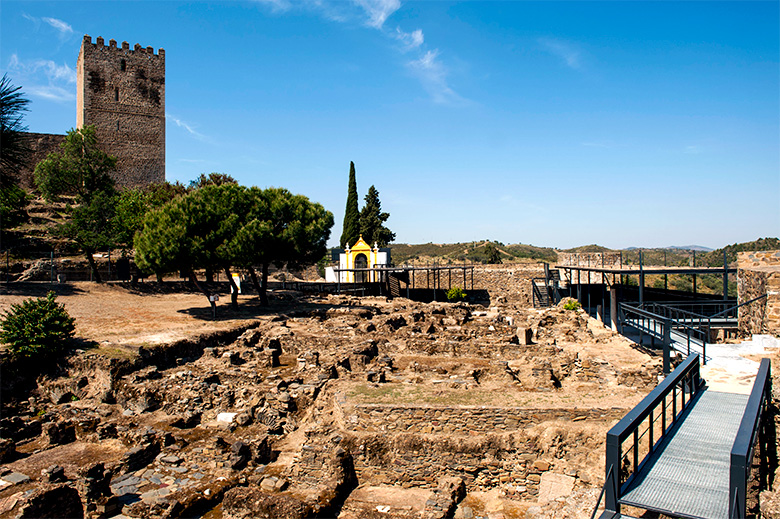
The Alcáçova (Islamic quarter), located in the highest part of the intramural area of the town of Mértola, was the military and religious center of the city: at the top, the imposing castle and, at its feet, the religious buildings that sanctified the whole complex. It was in this place, at the end of the 70s of the 20th century, that the historical-archaeological research project in Mértola began under the direction of Cláudio Torres. The most interesting element is the urban complex of the Islamic period, of which the remains of almost thirty houses are visible today. The Islamic quarter (Alcáçova) was built at the end of the 6th/12th century on a platform erected in the Byzantine period.

The complex repeats architectural patterns common to the Mediterranean urban world: the houses are organized around a central open courtyard and form a set of spaces whose functionality has been well defined (rooms, bedrooms, kitchens, latrines, etc.). In the complex superimposition of structures that always results from urban archaeological interventions, it is possible to clearly identify traces of streets, sanitation systems and pavements that bear witness to the last occupation of the Islamic citadel.

Of the urban complex of about 4,000 m² composed of thirty dwellings, fifteen remains have been discovered so far, nine of them complete and with perfectly legible planimetry. All of them were organized around a central open courtyard, a place that undoubtedly determines a spatial design mode and at the same time informs about the cultural habits of its inhabitants.

Since the beginning of excavations in 1978, the ancient citadel of Mértola has provided a large collection of materials from the Islamic period that have helped to produce knowledge about the daily life of the population of Mértola during the Islamic period. Work instruments, musical instruments, game pieces, kitchenware or tableware, and decorative pieces are today the great collection of archaeological remains of the Museum of Mértola, many of them exhibited in the collection of the Museum’s Islamic Art Center.

At the entrance to the Alcáçova complex you can visit a full-scale replica of one of the houses in the Islamic quarter.
Open for visits from Tuesday to Sunday from 9:00 am to 12:30 pm and from 2:00 pm to 5:00 pm.

Alcáçova de Mértola (Jorge Branco/CMM)

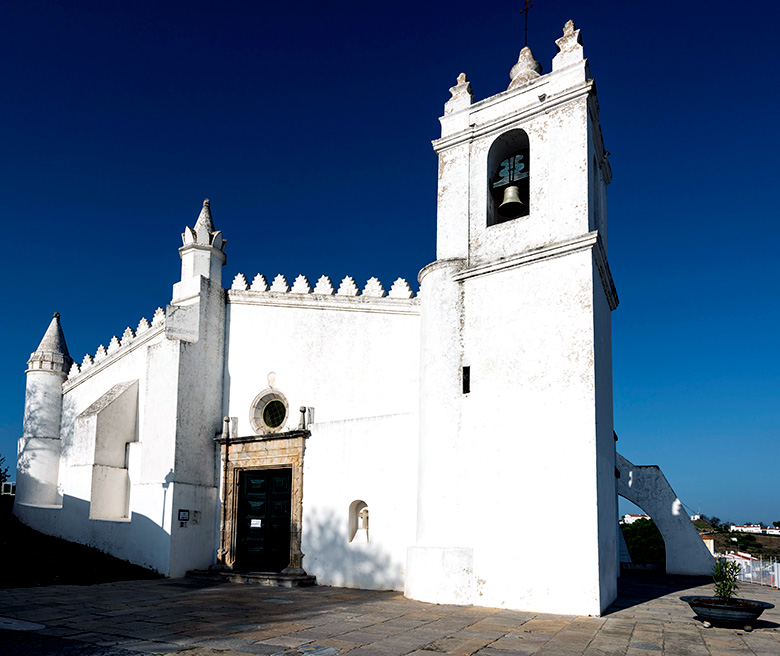
Matriz de Mértola Church/former mosque (12th century A.D.)

The Mother Church of Mértola is known for exhibiting a remarkable set of architectural elements inherited from its past as a place of worship, representative of various periods of history, including Roman, late antique, Islamic, medieval, modern and contemporary, the last 3 with affirmation as a Christian religious building.

In the Islamic period, in the 12th century, the site housed the Mosque of Mértola. The basic structure of the Mosque remained unchanged until the sixteenth century and the design of the duarte d’Armas reveals a building with five naves, each with a gable roof, of which four horseshoe arched doors framed by an alfiz, and inside the mirhab, are still preserved and can be seen today.

In 1238, the Lords of the Order of Santiago returned it to Christian worship. Only in 1532, when the building was already very degraded, work began on the construction of the vaults and the main entrance portal. In the 1950s, restoration work on the building made visible all the Islamic traces of the past. Today, the basement of the former 16th century sacristy shows the foundations of the building and reveals the various stages of occupation.

Open for visits from Tuesday to Sunday from 9:00 am to 12:30 pm and from 2:00 pm to 5:00 pm.

Iglesia Matriz de Mértola / Mezquita vieja (Jorge Branco/CMM)

Museum Núcleo de Arte Islámico (collection of archaeological materials)

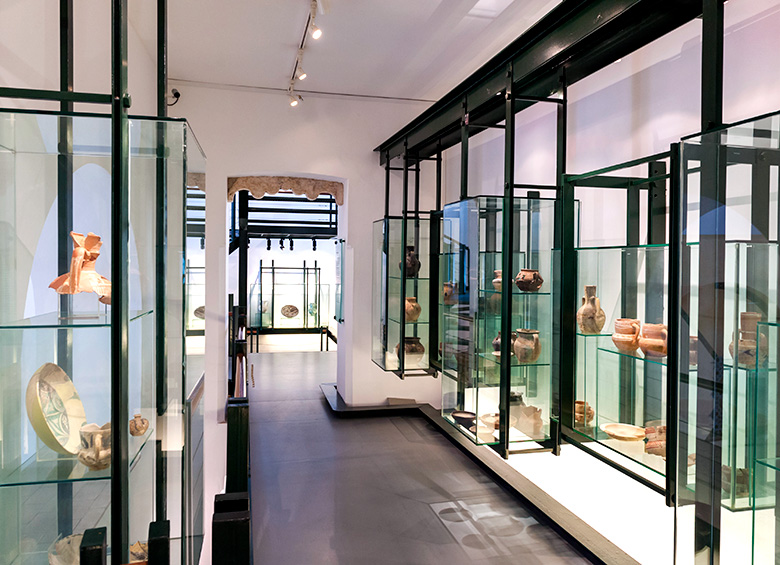
The Islamic Art Center of the Museum of Mértola is installed in an old barn, located next to the Porta da Ribeira. This was the main connection to the old port of Mértola. This is the result of 40 years of study and treatment of materials from the Islamic period, mostly collected in archaeological excavations carried out in Alcáçova de Mértola. The collection on display is representative of the ninth to thirteenth centuries and includes a wide variety of objects, including architectural elements, tombstones, ceramics, metals and glass, with emphasis on the collection of ceramic pieces decorated with the cuerda seca technique.

Open for visits from Tuesday to Sunday from 9:00 am to 12:30 pm and from 2:00 pm to 5:00 pm.

Museo Mértola/Centro de Arte Islámico (Jorge Branco/CMM)

Castle of Mértola (archaeological structures from the 11th century)

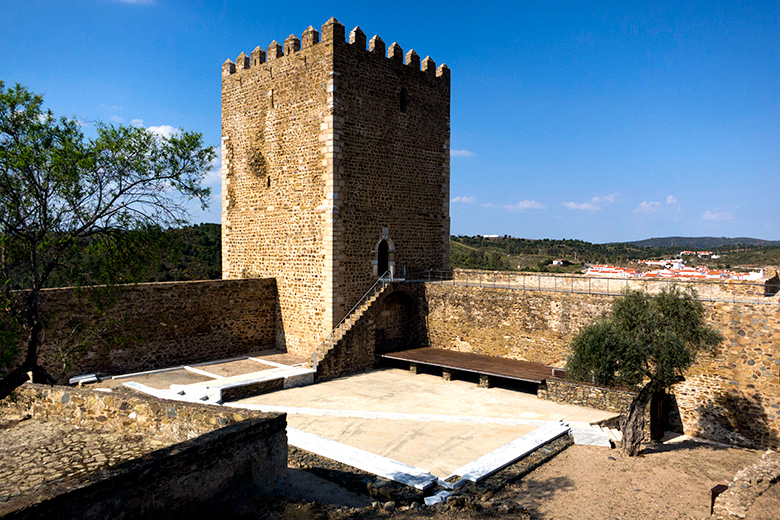
Gothic castle erected at the end of the 13th century by the knights of the Order of Santiago to serve as the home of the national branch of the order shortly after its autonomy against Castile, chronologically succeeds the “castreja” structures: an Iron Age fortress, a Roman “castellum” and a fortress from the Umayyad, Almoravid and Almohad periods.

Open for visits from Tuesday to Sunday from 9:00 am to 12:30 pm and from 2:00 pm to 5:00 pm.

Castelo de Mértola (Jorge Branco/CMM)

Islamic Festival of Mértola

The 1st Edition of the Islamic Festival of Mértola took place in 2001. The initiative takes place in the town of Mértola, every two years, in odd-numbered years, and is organized by the Municipality of Mértola in partnership with the local community and several local, national and international organizations.

The highlight of the event occurs with the street market (souk) that recreates the actual environment of a traditional North African measure. In the “souk” handicrafts, spices, sweets, local products and the mixture of voices give color, aroma and melody to the streets of the “old town” covered with colorful fabrics that protect visitors from the sun. Here and there a point of spontaneous animation emerges: a dancer, a poet or a singer. In an improvised space, up there, a nod reserved for prayer stands out.

The music takes place throughout the Festival. Arab-Andalusian, chaabi, gnawa, Berber, spiritual Sufi… traditional or contemporary notes, purist or fused, here the rhythms are invariably from the South and from common cultural bases. To the rhythms of the Arab world there is the melody of flamenco singing and flamenco.

The Festival celebrates the Arab heritage of the territory and the communion between cultures, affirming itself as a space of encounter, convergence and intercultural dialogue in the defense of the citizenship of all peoples.

Mértola Weaving Workshop

One of the oldest handicrafts in the municipality of Mértola is the weaving of wool blankets. The decorative motifs of the Mértola blankets are influenced by the Islamic past. We can find them in the objects used daily in the Islamic houses of the Alcáçova neighborhood.

In the weaving workshop, the weavers are in charge of ensuring that this tradition survives and keeps the complete wool cycle alive. Based on quality raw materials, they use traditional production techniques and antique decorative themes that are presented in blankets, rugs, carpets, socks, hats and other utilitarian or decorative objects.

Museum space, workshop and live weaving store, open daily from 9:00 am to 12:30 pm and from 2:00 pm to 5:30 pm.